
The Definitive Ohio FAQ Guide to Commercial Property Tax Assessment Appeals, Counsel, and Litigation
A practical reference for commercial and income producing property owners, CFOs, asset managers, and real estate decision makers.
Ohio property tax appeals materially affect investment performance, cash flow, and asset value for commercial property owners across the state.
The appeal process is procedural, evidence driven, and strategic.
Understanding the system is the first step toward managing it effectively.
This guide explains how experienced Ohio property tax attorneys evaluate assessments, valuation disputes, and litigation strategy before recommending action..
Understanding Ohio Property Tax Assessments
A property tax assessment is the county auditor’s determination of a property’s taxable value as of the January 1 tax lien date. This value is used to calculate the annual property tax obligation.
County auditors rely on mass appraisal systems that use one or more valuation approaches, including the income capitalization approach, sales comparison approach, and cost approach.
For income producing properties, the income approach is typically the most relevant. However, many county assessments rely on generalized assumptions that do not reflect property-specific financial performance.
The tax lien date is January 1 of the tax year. The property’s condition, income, occupancy, and market environment as of that date control valuation.
A reappraisal is a full countywide revaluation of all real property conducted by the county auditor.
A county update is an interim adjustment between reappraisals that reflects market changes and often results in valuation increases or decreases.
Ohio counties conduct a full reappraisal every six years and a market update every three years.
Ohio Property Tax Appeals Process
A property tax assessment appeal is a formal challenge to the county auditor’s valuation. The appeal seeks to establish a more accurate and defensible taxable value.
Appeals begin at the county Board of Revision.
The Board of Revision is a local tribunal that hears valuation complaints and issues decisions establishing taxable property values.
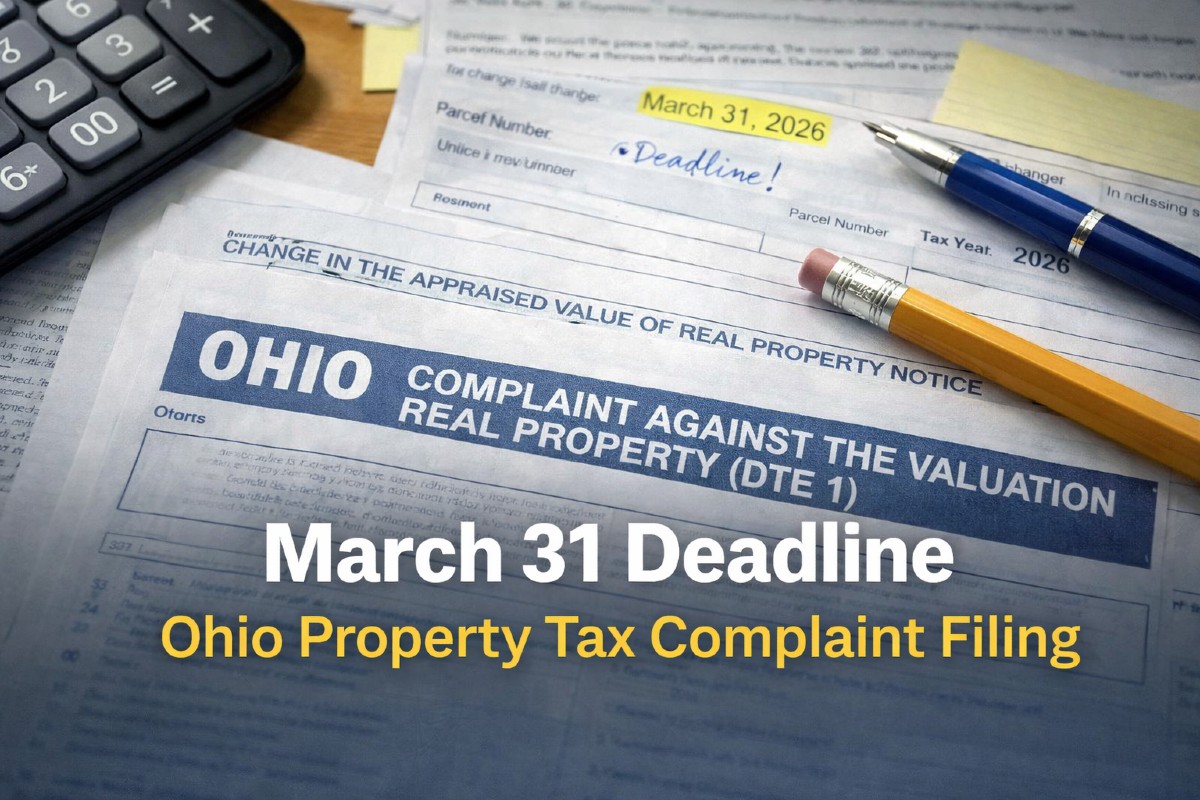
Appeals are filed using the Complaint Against Valuation of Real Property, commonly known as the DTE 1 form.
For most counties, valuation complaints must be filed between January 1 and March 31 of the tax year. Late filings are not accepted.
No. The deadline is statutory and cannot be extended.
Some counties allow electronic filing. Others require paper filing with original signatures.
Property owners, certain tenants, school boards, and municipal entities may file valuation complaints.
Generally No. In Ohio, a complaint can only be filed once per each triennial with limited exceptions.
After filing, the Board of Revision schedules a hearing. The property owner or counsel presents valuation evidence at the hearing.
Yes. Either the owner or the owner’s representative must appear.
Most cases take several months from filing to decision.
Evidence and Valuation for Ohio Property Tax Appeals
Common forms of valuation evidence include:
Appraisals
Income and expense statements
Rent rolls
Comparable sales
Vacancy data
Capital expenditures
Deferred maintenance documentation
No. Some cases can be resolved without an appraisal. Others require one, particularly when valuation disputes are substantial.
Sometimes, but financing appraisals are often not prepared to litigation standards and may not be persuasive in an appeal.
The income capitalization approach is typically the most relevant for income producing real estate.
Mass appraisal is a statistical valuation model used by counties to value thousands of properties at once.
They rely on generalized assumptions and lack property-specific analysis.
Yes. Vacancy can reduce value if properly documented.
Yes. Deferred maintenance may support a lower valuation when supported by credible evidence.
Yes. Capital improvements may increase value depending on timing and use.
Legal Representation and Litigation
No. However, commercial cases are highly technical and often benefit from experienced counsel.
When valuation is material, litigation is possible, or long-term valuation stability is important.
Property tax counsel:
Evaluates valuation
Develops legal strategy
Prepares filings
Handles hearings
Manages litigation
Coordinates appraisal strategy
The Ohio Board of Tax Appeals is a statewide tribunal that hears appeals from Board of Revision decisions.
Yes. Either party may appeal.
Appeals may be taken to the Ohio Board of Tax Appeals or the county Court of Common Pleas.
Generally 30 days from the date of the decision.
Proceedings may include discovery, motions, evidentiary hearings, and expert testimony.
Yes. Decisions may be appealed to the Ohio Supreme Court.
Litigation may take one to three years depending on complexity.
Financial and Portfolio Impact
If successful, a valuation reduction will reduce the tax bill.
Yes. Taxes must be paid when due.
Yes. Overpayments may be refunded or credited.
Yes. Precedent can affect future valuation years.
Yes. Strategic appeals can improve long-term valuation consistency.
Yes. Property tax strategy should be integrated into asset management.
Yes. Assessment exposure should be reviewed before acquisition.
Yes. Tax exposure affects pricing and underwriting.
Common Mistakes
Common mistakes include:
Filing appeals without strategy
Weak valuation evidence
Low quality appraisals
Settling too early
Treating appeals as one-time events
Yes. Poor litigation records can affect future valuations.
Yes. Unreasonable positions can damage credibility.
Professional Review
A professional review should include:
Property-specific financial analysis
Market benchmarking
Jurisdictional insight
Litigation risk assessment
Outcome modeling
Owners should expect transparency, strategy, and realistic guidance.
About SDG Legal
Sleggs, Danzinger & Gill is a property tax law firm representing commercial and institutional property owners nationwide, with deep experience across Ohio.
The firm focuses exclusively on valuation, assessment appeals, and property tax litigation.
Conclusion
Ohio property tax assessments materially affect investment performance, cash flow, and asset value.
The appeal process is procedural, evidence driven, and strategic and effective Ohio property tax appeals require more than a valuation argument. They require a defensible strategy that aligns with local procedure and long-term portfolio objectives.
Understanding the system is the first step toward managing it effectively.
If you would like to discuss your property’s assessment or appeal options, contact SDG Legal to speak with experienced property tax counsel.